Wednesday, February 18, 2009

Grindelwald Ski Report

English first/日本語は英語の後

I checked the weather forecast day after day, and realized that February 15h, Sunday would be sunny after the week-long rainy, snowy, and stormy weather. Therefore, I decided to go skiing. My next destination was Grindelwald. I rode a 6:01am Inter-City train from Basel via Bern to Interlaken Ost, (East). After arriving at Interlaken Ost at 7:57am, I transfered to the 8:05am mountain tram (named BOB). At Zweilütschinen (two stops away from Interlaken Ost), the train separated into two: one for Grindelwald and the other for Lauterbrunnen, from both of which one can however reach Jungraujoch. So, you can enjoy either a clockwise or counter-clockwise trip from Zweilütschinen through Grindelwalt, Jungfraujoch, and Lauterbrunnen back to Zweilütschinen.

The Jungfrau region has three ski areas from east to west: (1) Grindelwald - First, (2) Kleine Scheidegg - Männlichen, and (3)Mürren - Schilthorn. The second one, (i.e., Kleine Scheidegg - Männlichen) seems the biggest, and that's why I decided to ski there. However, The first gondola leading to this ski area does not actually starts from Grindelwald. As soon as I arrived at Gridelwald at 8:39am, I had to transfer to another mountain tram (called WAB) departing at 8:47am for Grindelwald Grund. But, the trick of this Snow'N'Rail pass is to exclude this short distance between Grindelwald and Grindelwald Grund. Furthermore, the pass requests a customer to obtain a lift ticket with the attached voucher here at the Gridnelwald station! Now, Murphy's law works as usual to such a short transfer time, for which there were a bunch of passengers including me who had to wait in front of two ticket counters. Needless to say, I had to wait for 30 more minutes to catch up the next tram (photo 1).

I arrived at Grund at 9:25am and rushed into the Intersport ski rental shop. From my previous lessons, I reserved a premium ski set. :-) Today's boots were Head. I became a little happy, because Head and Nordica boots tend to fit to my typical Japanese flat feet. (At Engelberg, I put on Salomon boots that were narrow enough to keep pressing the both sides of my feet.) However, despite their US size 8, I felt these Head boots were a bit too large, and asked a staff to get a one-size smaller pair, which were too tight and old Technica with some humidity. So, I ended up with the Head boots. It seems like they didn't classify boots in premium, economy, and even budget while the website did so with a different price. The skis they rated as premium were Salomon 3V race: http://www.snowrental.net/skiing/ski-equipment/salomon/2008/salomon-equipe-3v-race.html. (I'll tell you about how they were later in this blog.) Anyway, this rental shop charged me of premium skies and non-classified boots without any insurance, which was 65SFr in total. Hey, this was exactly the same amount as I paid two weeks ago at Engelberg for the economy skis, (i.e., Salomon Aeromax) and the insurance!

Anyway, when I got ready for skiing, it was already 9:50am. Then, Murphy's law worked again. I saw too many skiers slowly but eagerly moving toward only one small entrance of the gondola station like stagnant water almost clogged in a drain. It was just a chaos. No station staff arranged smooth gondola riding. In fact, I saw no staff helping skiers ride a lift all day long. This means every single lift-riding zone was just chaos unlike ski areas in US and Canada. It really appeared strange to me here in Switzerland where everything else is carried out under rules. I spent 1 hour before getting on this Europe-longest, 70s'-made, 4-people-riding, and tiny gondola which even took me 30 minutes to reach Männlichen, the first top of the mountains. There, the first thing I had to do was to insert my daily-use thin gloves into the boots' toes to adjust their fitness. It was 11:30am. More than 6 hours since I left my guest house.

Okay, I should talk about skiing and mountains. Visit the following website and click the map: http://www.jungfrauwinter.ch/pages/english/PST/isp.php?page=PST_KM_pst&data=B1_W

Slopes near by Männlichen (elv. 7317ft or 2230m, photo 2) were all groomed, packed powder, gradual, and thus very good for beginners. As a matter of fact, there were several groups in lesson. From there I saw Eiger, Mönch, and Jungfrau (photo 3), but their foot view was slightly blocked by two smaller mountains such as Tschuggen and Lauberhorn just standing in front of me. Behind these two is Kleine Scheidegg where I could enjoy a perfect view of the entire mountains. So, I had to hurry up. I skied down on course #4 to the Läger chairs. Salomon 3V ran fast, worked very stable, and carved the slope well. So, I clearly felt the difference between economy and premium skies. :-) From Läger, I skied on course #8 to the Gummi chairs. Gummi's right-side slope #16 had numerous ski tracks but still kept untracked spaces with deep fresh snow. Its sun-shining surface was really moving my mind if I should spend a little time to try it or save my time to Kleine Scheidegg. But, my wish to watch Eiger's north wll closer beat out my hesitation, and so I skied on #12 and rode Arven.

It was 12:30pm when arriving at Kleine Scheidegg where big mountain huts or actually hotels stood just next to the tram station. Right, if I hadn't depend on a Snow'N'Rail pass and had rent skis at Basel, I wouldn't have had to spend 90 minutes for riding the first gondola at Grund. The 8:47am mountain tram would've taken me from Grindelwald to Kleine Scheidegg by 9:20am, so that I could've saved 3+ hours. But no use to cry on spilt milk, because I was actually watching this astonishing view of these three mountains (photo 4). From here, I rode Lauberhorn to the place named Start Bar where I looked down the crowd of Kleine Scheidegg, while looking up Eiger, Mönch, and Jungfrau. The restaurant here was also packed with many skiers and the picnic area was full, too. No wonder, because it was 12:45pm on Sunday. So I kept skiing on #44 to the Fallboden chairs.

Again, many skiers were pouring into this double-seat lift. Despite that, I saw several chars occupied with just a single. This was because no staff controlled the waiting line and Swiss skiers still want to keep their privacy. This can't happen in Japan and of course in US. I recalled that, when a friend of my ski group inevitably used a chair of High Campbell at Crystal Mountain, WA without anyone else last year, the crowd repeated shouting "single! single!". But, it appears to me that skiers at Grindelwald must have a sort of contradictory feeling in that they want to get on a chair as soon as possible by a little aggressively approaching to the loading zone while wishing not to share a chair with strangers. Now, this gave me a good idea of where to have lunch. Yes, on a lift char. As I guessed, no one joined me for sharing a chair. Of course, I didn't hear yells of "single!". I took out from my daypack sandwiches and a water bottle (which I bought at Basel by 4.30SFr), and had lunch as enjoying a closer view of Eiger and Jungfrau on my right side from the lift chair for the next several minutes. But, I didn't imagine myself at the age of 45 just into hardcore skiing without any rests at a hut or a restaurant.

From Fallboden, I skied down on #25 to Salzegg. There was a sign saying "good skiers only" in multiple languages including Japanese (photo 5). Salzegg was a T-bar lift which was as steep as the very last section of the Horstman Glacier's T bar at Blackcomb but a way longer than that. This T-bar ride shows skiers a really close view of Eiger's north wall and some small holes below the middle, (which are probably sky lights or windows of Eiger's tunnel tram station). But don't be amazed too much with the view, you may lose your balance due to a variety of slopes.

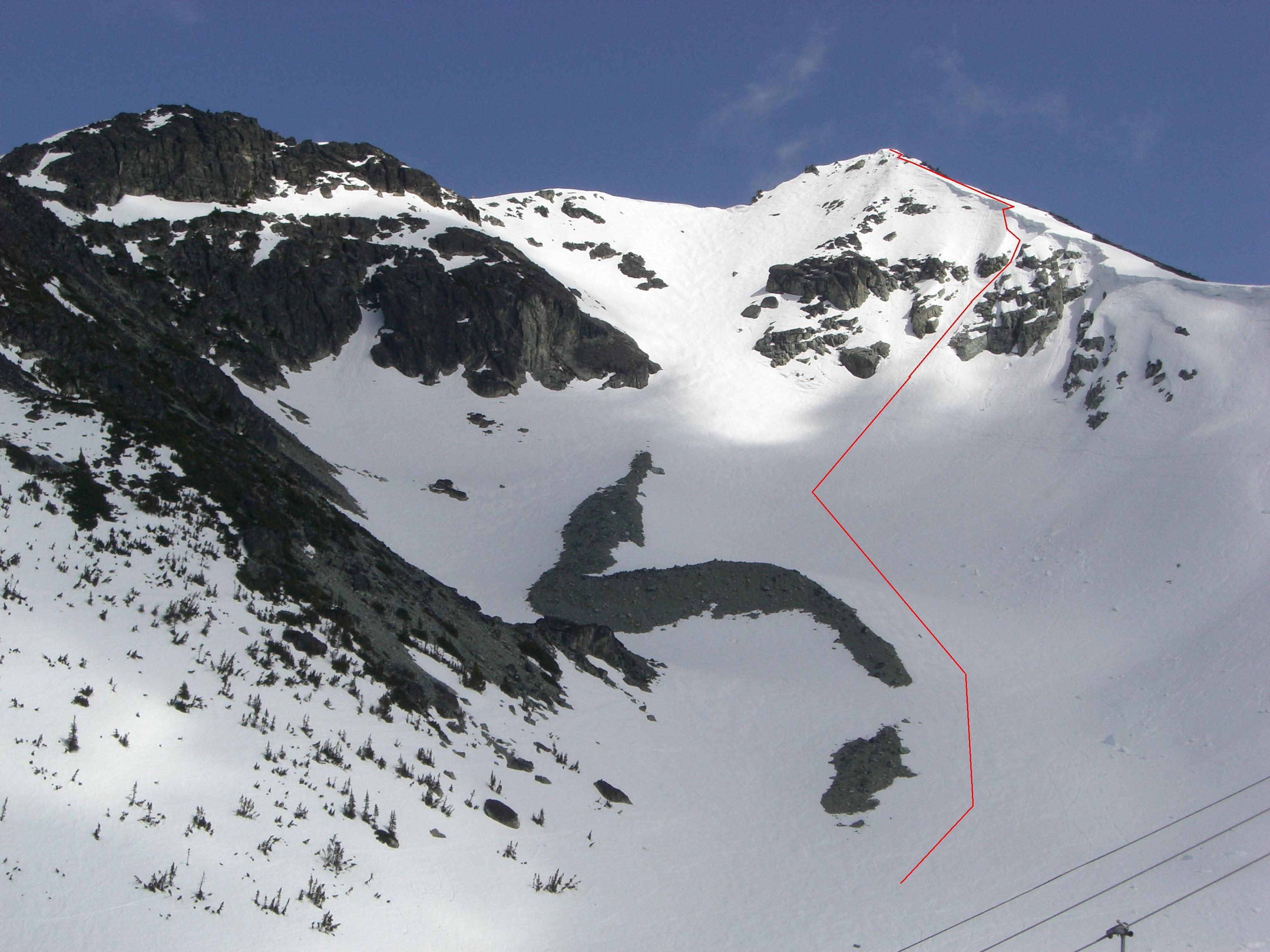
Now, I stood at Eigergletscher (elv: 7612ft, 2320m) which is the highest point accessible by lifts. If you want to go up higher to Jungfraujoch, you must take a tram but of course can't ski down on glaciers from there (photo 6). Two courses #27 and #32 can take me back to the base of Fallboden, the lift on which I had lunch. Course #32 was smooth but a bit icy. From the middle, it gave a couple of branches to deep fresh snow. I chose one but it was short and already crashed by many ski tracks. Course #27 was more interesting. Although I saw a left-arrow sign and several poles behind it, probably meaning that this is the course boundary, I didn't see any ropes or any written signs clearly saying "boundary". Therefore, without any guilty feelings I skied straight down toward the Fallboden lift. The slope still left some non-tracked space even around 2:30pm. While the slope was not so steep or didn't have so much snow as the last year's Campbell or Silver Basin at Crystal, WA, it was an enjoyable experience to ski in powder snow in the background of Eiger and Mönch (photo 7).

It was 3pm when I was back to Start Bar by riding Wixi. Now I wondered which option I should take, option 1 to Wengen, the other side of the mountain or option 2 back to Grindelwald through Männlichen. If I had taken option 1, it could have allowed me to ski through the entire Männlichen - Kleine Scheidegg area. But I came up with one concern about what if the gondola from Wengen back to Männlichen were too croweded so that I couldn't come back to Grindelwalt Grund by 6:30pm when the rental shop would close. So, I took option 2: skied down on #42, took Lauberhorn again, follwed #41 and then #21, rode Honegg, and skied back to the top of Gummi leading to #16, the very attractive slope I saw in the morning. However, I realized that all slopes on Gridelwald's side are facing east. This means that they were all shaded around 3:45pm. I tried #16 anyway. No one was there. The snow on the slope was completely crashed and a bit solid (photo 8). Then, I skied down on #7. Following was #21 that would take me straight to Grindelwald Grund). However, since I spent 90.80SFr for this Snow'N'Rail pass, 65SFr for the rental ski set, 7.44SFr for a round-trip ticket between Grindelwalt and Grund, and 4.30SFr for lunch, (and thus 167.54SFr all in total), I still had a feeling to ride as many lifts as possible and ski on as many slopes as possible. So, instead of going down on #21, I rode Tschuggen, skied on #6, took Läger, followed #3, and rode the Männlichen quad lift at 4:28pm, just two minutes before its closing time.

After making a pit stop at Männlichen, it was several minutes before 5pm. I was finally satisfied with riding all lifts and skiing down on all major courses except Wengen's side, (i.e., the west side of this ski resort). I skied down to Grund, returned the rental skis, and jumped on the 5:38pm WAB tram back to Grindelwald. I then took a chance of buying postcards and a budge for souvenir during this 7-miniute transfer time for the 5:49pm BOB train heading to Interlaken Ost. Of course, Murphy's law worked again, and the train left just about 30 feet ahead of me. So, I had to wait for 30 minutes again. The very last Murphy's law on that day worked to the Inter-City train I rode. The train delayed almost 30 minutes at Olten, just one stop before reaching Basel. So, the time when I came back to the guest house was about 9:30pm, one hour later than I planned on.

Now, let me conclude this long story with some bottom lines: (1) the Jungfrau region including these three ski areas is probably much larger than Whistler/Blackcomb; (2) you can ski anywhere you like, since there are almost no boundaries; (3) children and beginners can also ride any lifts except the Salzegg T bar and ski down as choosing easiest routes; (4) use trams as much as possible, because they are much more powerful mass transportations than gondolas and lifts; (5) try to start from Wengen via Lauterbrunnen, (i.e., the west side) so that you might be able to avoid crowd at Grindelwald and furthermore enjoy the east side of this ski resort in the morning as well as the west side in the afternoon as coming back to Wengen; (6) go straight up to the Eigergletscher station via Kleine Scheidegg using trams if you wish to experience deep fresh snow on courses #27 and #32; (7) rent premium skies but don't expect the quality of rental boots, which means you should bring your own boots if possible; and (8) try on-lift lunch so as to save your money and time if you don't care about enjoying the atmosphere of this world-class ski resort. :-)

Photos and a video are found the bottom of this blog. For more pictures, visit:
http://picasaweb.google.com/MunehiroFukuda/GrindelwaldSki

来る日も来る日も天気予報を調べたした結果、2月15日、日曜日は、1週間もの雨、雪、暴風と言った悪い天気の後のつかの間の晴天になると言う事が分かりました。よって、スキーに行く事にしました。今度の行き先は、グリンデルヴァルトです。朝6:01 バーゼル発、ベルン経由、インターラーケン東行きの都市間連絡列車に乗り、7:57に到着するや否や、8:05発のBOBと呼ばれる登山列車に乗り換えます。2つ目の駅のツバイルシネンで、列車はグリンデルヴァルト行きとラオターブルネン行きに分かれますが、その行き着く先は、(途中で別の登山列車に乗り換えますが)、両方ともユングフラウヨッホ展望台です。ですから、グリンデルヴァルト、ユングフラウヨッホ、ラオターブルネン、そして、ツバイルシネンへ戻ると言う時計回り、または、反時計回りの周回旅行を楽しむ事が出来ます。

ユングフラウ地域は、3つのスキー場から成っていて、東から西へ列挙すると、(1)グリンデルヴァルト ー フィルスト、(2)クライネ シャイデック ー メンリッヘン、(3)ミューレン ー シルトホーンになります。2番目のスキー場、(すなわち、クライネ シャイデック ー メンリッヘン)が最も大きい様なので、そこへスキーに行く事にしました。が、しかし、このスキー場につながる最初のゴンドラはグリンデルヴァルトから発車しません。8時39分にグリンデルヴァルトに到着後、8時47分発の(WABと呼ばれる)別の登山電車に乗り代えて、グリンデルヴァルト グルンドへ向かう必要があるのです。ここで、このスノー&レール切符の罠が待っていたのでした。このグリンデルヴァルトとグルンドの短い区間は、私の切符で乗れないのです。しかも、切符についている1日リフト券の引換券は、ここグリンデルヴァルト駅で交換せよって書いてあるのです。さあ、いつものように、マーフィーの法則(希望とは逆の事が起きる法則)がこの短い乗り換え時間に起きる訳です。つまり、2つしかない切符販売窓口に沢山の乗客が殺到しました。私もです。言うまでもなく、次の列車まで30分待つ事を余儀なくされました。(写真1)

グルンドに9時25分に着き、インタースポートスキーレンタルショップへ駆け込みます。以前の経験から、プレミアムスキー1式を予約しておきました。:-) 今日のスキー靴はヘッドでした。ヘッドとノルディカは私のような典型的日本人の扁平足に合うようなので、ちょっと嬉しい気持ちでした。(エンゲルバーグでは、サロモンを履きましたが、足の両脇がずっと締め付けられました。)しかしながら、米国のサイズ8(26cm)にもかかわらず、ヘッドのスキー靴はちょっと大きかったので、店員に一回り小さいのをお願いした所、今度はちょっぴり湿っぽくて、古い、かなりきつめのテクニカを持って来ました。結局、ヘッドにしましたが、どうも、この店はブーツをプレミアム、エコノミー、バジェットと言ったクラス分けをしていないようです。インターネットではそう宣伝していたんですけどね。この店がプレミアムとして扱っているスキーはと言うと、サロモン3Vレース(http://www.snowrental.net/skiing/ski-equipment/salomon/2008/salomon-equipe-3v-race.htm)です。後でこのスキーがどうだったかお話します。とにかく、このお店は、プレミアムスキーと特にクラス分けされていない靴を保険無しで65フランで貸してくれました。あれ、この値段は2週間前にエンゲルバーグでエコノミースキー(サロモン アエロマックス)、靴、それに保険を含めて支払った金額と同じじゃないですかってね。

とにかく、準備完了したのが、9時50分でした。そこで、また、マーフィーの法則が働きます。ゴンドラ駅の1つしかない小さな入口に大勢のスキー客がゆっくりと、でも結構押せ押せの感じで殺到しているのが見えます。まるで、洗面台に溜まって中々流れない水のようです。混沌としています。駅員がいなくて、全く客の流れが制御されていません。事実、その日は一日中、スキー客がリフトに乗るのに助けに出る係員は見かけませんでした。つまり、どのリフト乗り場も米国やカナダと違って、混沌としているのです。ここスイスでは何事も規則規則で事が運ぶ物だと思っていた私には、かなり奇異に見えました。このヨーロッパで一番長くて、70年代に運行を始めた、4人乗りの、小さなゴンドラに乗るのに1時間、さらに頂上に辿り着くまでに30分かかりました。そこで、先ずは、常用している薄手の手袋をスキー靴のつま先に充てて、足に合う様にしました。もう、11時30分です。ゲストハウスを出てから6時間以上も経ってしまいます。

そうですね、スキーと山の話に専念します。まずは、以下のウェブサイトを開いて、そこにある地図をクリックして下さい。http://www.jungfrauwinter.ch/pages/english/PST/isp.php?page=PST_KM_pst&data=B1_W

メンリッヘン(標高2230メートル、写真2)付近のコースは全て圧雪された固めの雪から成るなだらかな斜面で、初心者にはとても良いコースです。実際のところ、幾つかのグループが講習中でした。ここから、アイガー、メンヒ、ユングフラウの三山(写真3)が見えますが、麓の方が手前のシュッゲンとラオバーホーンという2つの山で隠れてしまいます。これら2山の背後にクライネ シャイデックがあり、そこで全体の山々が見えるものと思われます。そうです、急がないと。レガーリフトへ続く第4コースを滑り降ります。サロモン3Vのスキーは快速に滑り、安定していて、斜面をよく切る感じがしました。、そう、プレミアムとエコノミースキーの差がはっきり分かりましたよ。:-) レガーから、第8コースを降りてグミリフトに行きます。グミの右斜面、第16コースは、既にシュプールが一杯走っていましたが、それでもまだ滑走跡の無い深雪がキラキラと太陽に輝いています。ここでちょっと時間を潰そうか、それとも時間が勿体ないからクライネ シャイデックへ直行しようか迷いましたが、とにかく、近くでアイガーの北壁を見るとという意思が強く働いて、第12コースを滑り降り、アーベンリフトに乗りました。

クライネ シャイデックに到着したのは昼過ぎの12時30分、登山電車の駅の横に立派な山小屋と言うかホテルが経っています。そうです。もし、スノー&レール切符を使わずに、しかも、バーゼルでスキーを借りていれば、グルンドから最初のゴンドラに乗るのに、90分も費やさなくて良かったのです。グリンデルヴァルト8時47分発の登山電車にのれば、クライネ シャイテックには9時20分までに着いていて、3時間強も節約出来たはずでした。覆水盆に返らずな訳ですが、息を飲む様な山々の景色を目の当たりにしたのですから、良しとしましょう。(写真4)ここからラオバーホーンというリフトに乗って、スタートバーと呼ばれる場所に行きます。すると、眼下にクライネ シャイデックの賑わいが、頭上にアイガー、メンヒ、ユングフラウを見上げることができます。ここでもレストランはスキー客で一杯で、ピクニックエリアも座るところがありません。日曜の午後12時45分なので仕方ありません。それで、第44コースを使ってファルボーデンリフトへ向かいました。

またまた、大勢のスキー客がこのダブルリフトに殺到していました。にも関わらず、ダブルリフトをたった一人で乗っている客を数人見かけました。係員がいなくて待ち行列をちゃんと制御できないからか、スイスのスキー客はそれでもプライバシーを守りたいのか。こんな事、日本や、まして米国であり得ないです。そう言えば、昨年、スキー友達の1人がワシントン州のクリスタルマウンテンで仕方なく1人でリフトに乗ったとき、待っている大勢の客が「一人で乗ってるぞ」って非難囂々だったのを思い出しました。しかし、グリンデルヴァルトのスキー客は少しでもリフトへ詰め寄せて逸早く乗りたいと思う一方、やっぱり赤の他人とは一緒に乗りたく無いという矛盾した感覚なんでしょうか。そこでです、どこで昼飯にするか良い考えが浮かびました。はい、リフトに乗っている時です。思った通り、私と一緒にリフトに乗りたい奴は現れませんでした。もちろん、「一人で乗っているぞ」ってな罵倒も聞こえて来ません。バーゼルで4.30フランで買ったサンドウィッチと水をナップサックから取り出し、右手に迫り来るアイガーとユングフラウの眺めを満喫しながら昼飯にしたのでした。しかし、45歳にして、山小屋やレストランで休まずに根性スキーをする事になるとは思ってもいませんでした。

ファルボーデンリフトから、第25コースを下ってザルツェックに向かいます。複数の言語で、日本語でも「上級スキー客に限る」と書かれた看板を見かけました。(写真5)ザルツェックは、Tバーリフトでブラッコムスキー場のホーストマンTバーリフトの最後の方と同じくらい急で、しかもずっと長い坂を上ります。このTバーに乗ると、間近にアイガーの北壁を見る事ができます。そして、その壁の真ん中より下辺りに幾つかの穴が見えるのでした。(多分、アイガーのトンネル駅の天窓か何かと思われます。)しかし、景色に余り見とれていると、坂が起伏に富んでいてバランスを崩すかもしれないのでご注意を。

さあ、標高2320メートルのアイガー氷河駅に到着しました。ここが、リフトに乗り継いで来れる最高地点です。もし、これより先ユングフラウヨッホまで登りたければ、登山電車に乗って行くしかありませんが、もちろん頂上から氷河を滑り降りることは不可能です(写真6)。第27コースと第32コースが昼飯を食ったファルボーデンリフトへ戻るコースです。第32コースは滑らかでしたが、ちょっとアイスバーン気味で、中間から深雪へそれる脇道が2、3あります。その1つを選んで滑りましたが、短くてしかも既に相当数の滑走跡で雪が砕け散っていました。第27コースはもう少し面白いコースでした。左矢印の看板とその後ろに幾つもの杭が打ってあり、多分、ここがコースの端っこだよって諭しているものと思われますが、ロープも「コース外」と書かれた看板も見当たりません。それで、何の罪悪感も無く、ファルボーデンリフトに向かう坂を滑り降りました。斜面はもう午後2時30分になっているにも関わらず、滑走跡が無い所が残っています。斜面自体はワシントン州クリスタルマウンテンスキー場のキャンプベルやシルバーベースン コースほど急でもなく、雪も深くは無かったですが、アイガーやメンヒを背に柔らかい雪をかき分けスキーをするのは爽快でした(写真7)。

ヴィッヒ リフトに乗ってスタートバーと言う地点に戻ったのは3時頃でした。ここで、このスキー場の西側にあるヴェンゲンに向かうか、それともメンリッヘンに戻ってからグリンデルヴァルトに返るかの選択に迫られました。ヴェンゲンに向かえばこのメンリッヘン ー クライネシャイデックのスキー場全体を滑った事になります。しかし、もし、ヴェンゲンからメンリッヘンに戻るゴンドラが混雑して、6時30分までにグリンデルヴァルトグルンドに辿り着かないと、貸しスキー屋さんは閉まってしまいます。それで、メンリッヘンに戻るコースを選択しました。第42コースを降り、再びラオバーホーンリフトに乗って、第41、第21コースを滑り、ホネックに乗って、グミリフトの頂上まで滑り降りました。今朝見た結構面白そうな第16コースに辿り着いた訳です。しかし、グリンデルヴァルト側のコースは全て東向きだということに気が付きました。つまり、午後3時45分の時点で、これらのコースは皆日陰になってしまっていました。とにかく、第16コースを滑ってみる事にしました。誰もいません。斜面の雪も完全に砕け散って、少し固くなっています(写真8)。それから、第7コースを降ります。それに続くのは第21コースで、これはグリンデルヴァルトグルンドまで一直線に降りれるコースです。しかしながらです。このスノー&レール切符に90.80フラン、貸しスキーに65フラン、グリンデルヴァルトとグルンド間の往復切符に7.44フラン、昼飯に4.30フラン、(総計167.54フラン、13400円)を使ったからには、できる限りリフトに乗り、斜面を滑って元を取らなければなりません。それで、第21コースを使わずに、シュッゲンTバーリフトに乗り、第7コースを使い、レガーに乗り継いで、更に第3コースを下って、4時28分、リフト運行終了時間2分前にメンリッヘン4人乗りリフトに滑り込みました。

メンリッヘンでトイレ休憩したときには、既に5時数分前。ようやく、ベンゲン側(西側)を除く全てのリフト、全ての大きなコースを試す事ができ、満足感が湧いて来ました。グルンドへ滑降し、スキーを返して、5時38分発のWAB登山電車に飛び乗ってグリンデルヴァルトへ戻りました。ここで、5時49分発インターラーケン東行きのBOB登山電車まで7分間の乗り換え時間があり、一か八か、お土産に絵はがきとバッジを買う事にしました。もちろん、マーフィーの法則がまた働いて、電車まであと10メートルと言うところで乗り遅れて、再度30分余計に待つ羽目になった訳です。それでもって、その日の最後のマーフィーの法則は、帰りの都市連絡列車で起きたのです。バーゼルまでもう1駅のオルテンという所で列車が故障して30分遅れました。結局、ゲストハウスに戻ったのは、予定より1時間遅い夜の9時30分頃でした。

さて、この長いお話の後は、おさらいです。(1)ユングフラウ地域は、3つのスキー場を含むと、多分、ウィスラーブラッコムより遥かに大きい。(2)コースの境界線が殆ど見当たらないので、どこを滑っても良い。(3)ザルツェックTバーリフトを除けば、子供も初心者もどのリフトに乗っても良くて、初心者コースを使って降りて来れる。(4)出来る限り登山電車を利用しましょう。というのは、ゴンドラやリフトより遥かに輸送力が高いから。(5)ラオターブルネン経由でベンゲン側(西側)からスキーを始めれば、グリンデルヴァルトの混雑を避け、午前に東斜面、午後に西斜面を滑って、ベンゲンにもどって来れそうです。(6)もし、第27、第32コースの深雪を満喫したければ、登山電車を使ってクライネシャイデック経由でアイガー氷河駅まで直行しましょう。(7)プレミアムスキーを借りるべきだが、もう貸し靴を期待してはいけません。つまり、出来る事なら、自分の靴を持参しましょう。(8)もし、この世界的な規模のスキーリゾートの雰囲気を楽しむことにそれほど執着していなければ、リフトで昼飯を食って、お金と時間を節約しましょう。:-)

全ての写真は、ここをクリック:
http://picasaweb.google.com/MunehiroFukuda/GrindelwaldSki

Photo 1: Transferring at Grindelwald


Photo 2: Arriving at Männlichen by gondola


Photo 3: A view from Männlichen


Photo 4: Kliene Scheidegg in the background of Eiger and Mönch


Photo 5: A warning sign at the Salzegg T-bar lift


Photo 6: The glacier view from Eigergletscher (elv: 7612ft, 2320m)


Photo 7: My ski track as if it flowed from Mönch


Photo 8: Course #16 shaded at 3:45pm


Video: an entire view from Kleine Scheidegg

Monday, February 2, 2009

Mt. Titlis Ski Report

English first / 日本語は英語の後

After spending almost a month here at Basel, now this time finally came. I got information on near-by ski areas, purchased a one-year half-price travel card from SBB (Schweizerische Bundesbahnen in German or Swiss Federal Railways in English), and bought a snow-N-rail discount package including a round-trip ticket to Engelberg, a day lift ticket at Mt. Titlis, and a 18% ski-rental discount at Inter Ski Rental.

Engelberg, (i.e., Angel's Town) is the base for getting access to Mt. Titlis and is located 85 miles, (= 136 km) southeast from Basel, which, if I think about going skiing from Seattle, is a way farther than Snoqualmie, yet a bit father than Stevens Pass and Crystal Mountain, but much closer than Mt. Baker, (probably even before Bellingham.) Comparing its distance with ski areas close by Tokyo, Engelberg is much closer than any ski areas in Gunma and Tochigi prefectures but probably in the same distance to Karuizawa. Unlike all ski areas in Washington State, Engelberg is accessible by train. An inter-city express departs every hour from Basel. Of course, I got on the very first train at 6:03am, transfered to a mountain railway at Luzern, and arrived at Engelberg at 8:12am.

Amazing was this mountain railway. Waking up at 4:30am, I dozed off in the train, but suddenly felt the train now running up a super-steep slope. While automobiles were driving up on a zigzag road, the train went up straight like a cable car (watch the attached video clip). Again if I compare it with my experience, the gradient is much larger than Hakone Mountain Railway in Japan. I think Kent, my son would really enjoy riding this train when he comes to Switzerland in March.

The Mt. Titlis cable car station is just only a 3-minute "free" bus ride from Engelberg (see photo 1 below), where I rent a ski gear. (To be honest, I mistakenly stopped by a different Inter-Ski rental shop near by the Engelberg station that leases even ski wears and of course has restrooms (probably used for changing cloths). However, this cable car station has nowhere to change cloths except a tiny restroom fully packed with skiers and tourists. That was the reason why I saw many skiers already wore a ski wear and even ski boots in the train. On the other hand, a lot of 2-sfr (= $2) lockers were available to use. Despite that everything is expensive in Switzerland, it is quite reasonable to use a spacious locker at $2 that can even store a pair of skis.

To reach the top of Mt. Titlis (with elevation 10000 ft = 3020m), skiers need to ride the cable car first and thereafter transfer to the 1st, 2nd, and even 3rd gondola (photo 2). Although this series of rides would give a kind of sensational experience to tourists, (and of course to my son if he has a chance of coming here), upon every transfer, I had to wait on a long line for the next gondola, (like the Hakone cable car and rope way in Japan), which took about one hour in total to get to the top.

Finally, I arrived there at 10:40am, (after spending 5+ hours from the university guest house!) The view was just like the heaven as if angels were landing soon. The beautiful and gigantic rocks color-striped in horizon with snow's white and rocks' gray slightly reminded me of the view I saw at Alta in Utah, it was stunningly overwhelming and beautiful as if they were islands floating on the sea of white clouds. Check photos 3 ~ 7.

Now, it's time to ski down. It was my first skiing in this season which was 2+ months later than usual, (i.e. mid November). I saved my money by rending economy skis and boots at 60 sfr (= $60) rather than a premium set at $80. Okay, my excuse is enough. Yes, you can imagine. To accelerate my speed, I just skied straight down, and quickly noticed that skis were bouncing, shaking, and vibrating, which was because I forgot to put my center of mass on the right position of the skis? Or was it because of these cheap and lightweight skis? To be worse, the left ski's tip caught snow too much while its tail was rotating quickly during my first right turn, and I almost fell down at the beginning of my first skiing in Switzerland! Anyway, I recovered my body position quickly and fortunately didn't fall down at all during the day. :-) The actual tip was that, after my first run down to the mid station at 2428m, I switched the left and right ski, which made me much comfortable. Or I got used to the skis.

The snow condition was so-called packed powder or a bit icy. Almost all slopes were non-gloomed runs. Still 90% were smooth surfaces, while the rest were bumpy slopes. Those bumpy slopes were icy but not so steep. All in all I didn't see quite steep slopes on piste. All slopes on piste were guarded by ropes and I saw many signs saying "stay in course, many crevices ahead", which scared me of crossing the rope to off-piste slopes that however seemed easy to ski down because of numerous traces on them. In fact, I constantly saw several skiers skiing down these slopes. Only one concern was that off-piste courses from the top of Mt. Titlis at 3028m to the mid gondola station at 1800m named Starterland seemed like leading to a big plateau on their way, (i.e, Steinberg in the map: http://www.myswitzerland.com/wispo_images/karten/723_KARTE.jpg) where skiers would have to detour to either side of it, or make a fatal jump from the edge of the plateau. Repeatedly saying, the slopes were not so steep like this (http://faculty.washington.edu/mfukuda/blackcomb.jpg). So, if I skied with my B3 and together with Shu-san and Kato-san, my ski school colleagues, I would probably follow their devil's whisper: why not? (And, I would reglet about my decision on my way. :-))

Since I spent 83.40sfr for a Snow'N'Rail package, $65sfr for this rental ski gear, 19.5sfr for lunch, and even .5sfr for using a restroom at the Engelberg station, all of that brought the total to 168.4sfr, (excluding a 150sfr half-price travel card), I really wanted to try all slopes, and within 5 hours I did so except #7 and #10, which were worthlessly easy. The course #1 from Gletscherlift to Stand (a yellow line in the map) was the most difficult and bumpiest course that was however not so difficult as Snoqualmie Alpental's International but probably the same level as the upper slope beside its quad chairs. See photo 8. Then, how about skiers' skill at Mt. Titlis? Well, I believe that best skiers must have all gone for off-piste skiing.

The quality of 19.50sfr lunch was probably the same as Timber Wolf at Snoqualmie West . Noodles, two pieces of warm spam meat, and steamed baby cabbages which must have been taken out from frozen packages. It seems like paying 1000 yen, ($11) for curry and rice at the Naeba ski resort in Japan, which I think may be taken out from instant packages. To be worse, they don't accept a credit card if a customer don't spend more than 20sfr, for which purpose there were a bunch of drinks just before the cashiers, each actually with 5sfr. Since most people don't want to carry cash with them, they end up with picking up one of them, which I think is a way of the restaurant business.

In summary, the view was the most impressive among all ski resorts I visited; there was not so much snow as last year's Crystal Mountain and of course as Mt. Baker; the snow condition on piste was slightly icy like Alpental's Upper International; the scale of Mt. Titlis is definitely larger than all Washington State ski areas but smaller than Whistler BC, maybe the same as Snowbird UT; you should rend premium ski gear (if you need) by bringing your own lunch instead of buying a $19.5 lunch set; and there were much less annoying snowboarders than Washington State!

Finally, although all seats of the train returning to Luzern were taken by skiers, a half of them got off on the way to Luzern, which means that local skiers commute using this lovely mountain railway. When I arrived back at the university guest house, it was 8:20pm.

Please visit: http://picasaweb.google.com/MunehiroFukuda/MtTitlisSki

バーゼルで過ごしてもうすぐ1ヶ月、ようやくこの時がやってきました。近辺のスキー場情報を収集し、スイス国鉄から1年間有効の半額パスを購入し、エンゲルバーグへの往復、ティトリス山の1日券、それにレンタルスキー18%割引のクーポン込みのスノー&レール切符を買いました。

エンゲルバーグ、(つまり、天使の町)は、ティトリス山麓の町で、バーゼルから南西に約136Kmのところにあります。シアトルからスキーに行くと考えると、スノクオルミーより遥かに遠く、ステーブンズ峠やクリスタルマウンテンよりもまだちょっと遠いですが、マウントベーカーよりは断然近い、(多分途中のベリンガムよりも手前だ)と思います。東京から行けるスキー場と比べてみると、群馬、栃木の両県のスキー場よりもずっと近いですが、おそらく軽井沢と同じ位の距離にあるでしょう。ワシントン州のスキー場とは違って、エンゲルバーグは列車で行けます。バーゼルからは1時間毎に特急が走っています。もちろん6時3分発の始発に乗り、ルッツェルンで登山電車に乗り換え、エンゲルバーグに着いたのは8時12分でした。

面白かったのは、この登山電車です。4時半に起きたので、電車の中でうたた寝してしまったんですが、気が付いてみると電車は超急勾配の坂を上っています。自動車がスピンカーブの道をのぼっているところを、この電車はまるでケーブルカーの様に直進して行くのです。添付のビデオをご覧下さい。再度、自分の経験と比較すると、日本の箱根登山線より遥かに急勾配です。息子の健人が3月にスイスにくるとき、この電車に乗ったら喜ぶだろうなと思いました。

ティトリス山麓のケーブルカー駅までは、エンゲルバーグからタダでバスが出ていて3分で着きます(添付の写真1参照)。そこで、スキーを借りました。(正直に言うと、間違って、エンゲルバーグ駅近くの別のインタースキレンタルというレンタルショップに立ち寄ってしまったんですが、そこではスキーウェアーも貸し出していて、もちろん着替えに使えそうなトイレもありました。)ところが、このケーブルカー駅には着替えるとこが、スキーヤーや観光客が大勢待っている本当に小さいトイレ1つしかありません。だから、電車に乗っているスキーヤーは既にスキーウェアーに着替えていて、スキー靴さえ履いていたのだなと思った訳です。その一方で、ロッカーが2フラン(=2ドル)で利用可能で、何でも高いスイスの割には、スキーも格納できる大きなロッカーを2ドルで使えるのはお手頃でした。

ティトリス山頂(標高1万フィート、3020メートル)に到達するには、まずケーブルカーに乗り、さらに3回ゴンドラに乗り換える必要があります(写真2参照)。こういう数々の乗り物は観光客に、(もちろん、うちの息子にも)、ある意味、感激的かと思いますが、乗り換え毎に、次のゴンドラの乗車待ちの長い列に並ぶ必要があり、頂上に辿り着くまでに全部で約1時間もかかってしまいました。

ようやく頂上に到着したのが10時40分でした。(大学のゲストハウスを出発して5時間強かかりました。)眺めは確かに天使が今直ぐにでも舞い降りて来そうな天国のような感じです。豪華絢爛とでも申しましょうか、周りの岩々は雪の白さと岩の灰色とで横縞模様になっていて、あたかもユタ州のアルタスキー場を彷彿させるのですが、とにかく規模が半端じゃなくて、山々が白い雲海に浮かぶ島のように見えるのです。写真3〜7を参照。

さて、スキーで滑るとします。いつもより2ヶ月ちょっと遅い、(普通なら11月中旬には滑るのですが)初滑りです。お金をケチって、80ドルのプレミアムレンタルではなくて、60ドルのエコノミースキーを借りました。そう、言い訳は十分ですね。想像できると思います。加速するために、まずは直滑降したのですが、スキーがバタバタと振動するはブレるは、えっ、スキーの乗り方忘れちゃったかいな、それとも、この安くて超軽いスキーのせい?さらに悪い事には、最初の右ターンで、左スキーのトップが引っかかると思いきや、テールがずるずると横滑りするは、スイスで最初のスキーでいきなり、転倒かいな。いやいや、直ぐに持ちこたえて、幸いにもその日は1度も転倒することなく滑れました。2428メートルのゴンドラ中間駅まで滑り降りて、右と左のスキーを履き替えたのが幸いだったのか、後は楽に滑れるようになりました。それとも、そのスキーに慣れたせいか。

雪質は、所謂、ぎゅっと固まった粉雪というか、ちょっとアイスバーン気味な感じ。どの斜面も整地されていませんでした。ただ、90%の斜面は滑らかで、残りの10%はコブ斜面です。これらのコブ斜面はアイスバーンですが、急ではないです。結局、ゲレンデの外でスキーをすることはありませんでした。ゲレンデ内の全てのコースはロープで仕切られていて、「前方クレパス有り、コースに留まれ」っていう標識が結構あって、ロープを潜って場外スキーをするには、ちょいビビってしまうのでした。が、しかし、ゲレンデ外の斜面は、相当のシュプール跡が残っているので滑り降りるのはそんなに難しく無いのではとも思われます。事実、いつも何人かのスキーヤーがコース外の斜面を滑り降りているのを見かけました。ただ、1つ懸念するとすれば、3028mのティトリス山頂から1800mのゴンドラ中間駅(スターターランド)までのゲレンデ外コースは、途中の大きな台地(地図http://www.myswitzerland.com/wispo_images/karten/723_KARTE.jpgではスタインベルグという所)につながっていて、そこからスキーヤーは脇のコースを辿って行かないといけないらしい、さも無くば、崖っぷちから飛び降りて死ぬしかないでしょう。繰り返し言うと、斜面は、http://faculty.washington.edu/mfukuda/blackcomb.jpg程急じゃない。そう、もし自分のB3スキーをはいていて、しかも、スキー学校の同僚の秀さんや加藤さんと一緒ならば、「滑らないの?」って言う彼らの悪魔の囁きに多分付いて行ってしまうでしょう。(そして、途中でやっぱり止めときゃ良かったって後悔する訳ですが。)

このスノー&レール券に83.40フラン、スキーレンタルに65フラン、昼飯に19.5フラン、ついでにエンゲルバーグ駅構内のトイレを使って0.5フラン、合計168.4フラン(もちろん、半額カード150フランを含めてませんよ)を支払ったからには、全ての斜面を制覇したいというのが心情で、5時間で第7、10コース(これらは初級で滑る価値がない)を除く斜面を滑り降りました。グレーシャーリフト(氷河リフト)からスタンド(降り場とでも申しましょうか)までの第1コース(地図上では黄色の線)が最も難しくコブコブのコースでしたが、スノクオルミー、アルペンタルのインターナショナルコース程は難しく無く、多分、4人乗りリフト横の上の斜面と同じ位の難度だと思われます。写真8を参照。それで、ティトリス山のスキーヤーのレベルは?っていうと、上級者達は、皆ゲレンデ外のコースに言ってしまったんだろうと思います。

19.5フランの昼飯の質はというと、多分、スノクオルミーのティンバーウォルフレストランと同じくらい。麺、それと、缶詰のコンビーフっていうか、とにかく缶詰肉2切れ、冷凍食品とおもわれるミニキャベツの暖めたのです。日本で例えると、苗場スキー場のカレーライス(どうせインスタントなんだけど)に千円払うようなものです。更に悪い事には、20フラン以上使わないと、クレジットカードを受け付けてくれない。だから、レジの前に飲み物がどっさり置いてあって、それが何と5フラン(500円)。殆どの客は、現金をそんなに持ち歩いていないから、結局、飲み物を1つ選ぶ羽目になるわけど、これが、レストラン業界の使う手なんでしょうね。

さて、総括です。眺めは今まで行ったスキー場の中で最も印象的。雪の量は、去年のクリスタルマウンテン程でもなく、ましてやマウントペーカーより少ない。雪質はアルペンタルのインターナショナルの上の方と似ていてちょっとアイスバーン気味、ティトリス山の雄大さは、確かにワシントン州のどのスキー場よりも大きいですが、カナダのウィスラーよりは小さくて、多分ユタのスノーバードと同じくらい。(スキーを借りる必要があるならば、)昼飯は19.5ドル分を自分で用意して、プレミアムを借りるべき。そして、何よりワシントン州よりも遥かに、あの苛つくボーダーの数が少ない!

最後に、帰りのルッツェルン行きの電車は皆スキーヤーで一杯でしたが、半分は途中で下車するので、地元スキーはこのかわいい登山電車で通うらしいです。それで、大学のゲストハウスに戻ったのは、夜の8時20分でした。

写真はここ: http://picasaweb.google.com/MunehiroFukuda/MtTitlisSki


Photo 1: Mt. Titlis Cable Car Station


Photo 2: Transferring to a gondola


Photo 3: Up beyond the sea of clouds


Photo 4: Now reaching to the top


Photo 5: Looking north from the top


Photo 6: Looking south from the top


Photo 7: Rocks floating on the sea of clouds


Photo 8: The most difficult slope?


Video 1: In the mountain railway train

Friday, January 9, 2009

Arriving at Basel, Switzerland


English first / 日本語は英語の後

I declare to resume my blog upon moving my sabbatical research base from Japan to Switzerland.

At 1pm on January 5th, I left Japan for London with BA008. When the aircraft made a final approach to the airport after its 12-hour flight, it still had to make an additional 30-minute circular flight so as to wait for ice/snow to be removed from the runway. The flight from London to Basel was one hour delayed, too for removing ice from its wings. My arrival at Basel was 10:20pm, 17 hours after my departure from Japan. I had four meals in the flights. Surprisingly, Basel has passengers pick up their baggages before going through the immigration. I now got anxious about what an immigration officer would say to me as seeing me carrying two large/heavy suitcases. He certainly didn't think that I was a tourist, began to open each page of my passport, and finally asked me, "for business?" I replied "YES", which for some reason prompted him to stamp my passport. While it took more time than the passport control at Lisbon, it was actually simple.

When exiting from the terminal building, I saw snow falling heavily. No bus services at all. Even if they had been available, I couldn't have got on a bus with these heavy suitcases, and thus walked straight to a taxi stop. No passengers waiting. The meter started with 7SFR, (i.e., $7.00), which seemed like an appropriate initial fare as compared to the taxi service near by Keio University, Japan. However, the meter raised the fare really quickly as if it malfunctioned! The fare went up to 7.20SFR within 20 meters or 66 feet, further up through 7.40 to 7.60 while the taxi was still driving on the rotary. It already went up beyond 10SFR (= $10) when leaving this small airport and reached 34SFR in several minutes to the hotel. Although I heard that swiss taxis are the most expensive over the world, this fare was just more than my estimation.

The hotel was a 4-star hotel and cost 130SFR/night for a single. This is what a staff of the university guest house recommended. Although it was very clean, I just felt "that's it??" A tiny room. Furthermore, there was an ash tray on the table. Probably the hotel staff guessed that all Japanese like to smoke. The bath room prepared only all-in-one liquid of shampoo + shower gel. I was too tired and sleepy to go back to and give my complaint to the reception. Free breakfast was included, eggs were cooked upon each guest's request, and many choices of food were served, all of which I thought were a matter of course with 130SFR.

Now, it was time to move in the university guest house. I already got sick of such an expensive taxi. I walked, and even went up and down on stairways with these two heavy suitcases in the city for 10 minutes under the snowy weather. Of course, all pedestrians curiously looked at me. If I did the same thing in US, there might be someone who could ask me "do you need a help?". But it seems like Swiss are as unfriendly to strangers as Japanese are. As I arrived at the guest house at the appointment time, a staff was standing at the entrance and immediately guided me to my room. Probably Japan could give the same level of smooth services as Switzerland does, but this wouldn't happen in Portugal where a bunch of problems happen: the staff wouldn't show up as scheduled, the room wouldn't be ready yet, etc.. I giggled in my mind as guessing these troubles. The guest house room was spacier than expected, including a king bed, an immediate Internet connection, a cable TV, a phone, and a periodic room clean-up with linen replacement, all of which cost just 910SFR/month. What a big difference from the last night's 130SFR for the hotel room!

サバティカル中の研究拠点を日本から、スイスに移したので、これを期にブログを再開します。

1月5日、午後1時発の英国航空8便でロンドンに向かいました。12時間かけてロンドンに近づくも、ヒースロー空港の滑走路が凍結していて、上空で30分旋回。ロンドンからバーゼルに向かう飛行機も、翼の氷を解凍するのに1時間遅れました。バーゼルに到着したのは、夜10時20分、成田を出発してから、17時間後でした。その間、機内で4回飯を食いました。バーゼル空港では、入国審査の前に荷物を受け取ります。う~ん、でかいスーツケースを2つ持っている私を見て、審査官は何て言うだろうって不安が横切りました。案の定、パスポートを1ページずつめくり始めました。さすがに、観光じゃないだろうと思ったらしく、ビジネスかって聞いて来ましたが、「はい」と言ったら、直ぐさまスタンプを押して、審査終了です。リスボンより時間がかかりましたが、以外に簡単でた。

到着口を出ると、雪が津々とふっています。さすがに連絡バスなど見当たらないし、あっても、この重たいスーツケースを持ってバスに乗る事もできません。それで、タクシー乗り場に直行。客など誰もいません。料金は7フラン(700円程度)から始まりました。湘南台のタクシーと比べて妥当な相場と思いきや、20メートルも進まないうちに、カチと言って7.20になり、ロータリーを廻っているときも、7.40, 7.60と異常な速さでメータが上がって行きます。空港を出るときには、既に10フランは軽く超え、7, 8分しか乗っていないのに、ホテルまで34フランでした。スイスのタクシーは、世界一高いとは聞いていましたが、これ程だとは思っていませんでした。

ホテルは、大学のゲストハウスのおばさんが進めてくれたところで、4つ星で、一泊130フラン。部屋は清潔感はあるものの、130フランでこれだけ? おまけに日本人はタバコ吸うだろうと思ったらしく、灰皿までテーブルに置いてあって、バスルームにはシャンプ+シャワージェル兼用の液体があるだけ。思わず、引き返して文句言おうと思いましたが、既に夜11時過ぎ、疲れて寝ました。翌日の朝食は、卵をその場で調理してくれたり、種類も豊富でしたが、130フラン払ってるんだからね、当然かな。

さて、いよいよ、ゲストハウスに入居です。もうタクシーは懲り懲り。雪の降る中、スーツケース2つを転がしながら、市内を10分歩いて移動しました。歩行者は皆、変な目で見てましたね。多分、アメリカでは助けましょうかって言ってくる人が出てくるかもしれないけど、スイス人はそこまで親切ではない。日本人も同じ。予定の時間に到着すると、管理人が玄関で待ち構えていて、直ぐに部屋に案内してくれました。日本でも、これくらいスムーズだと思うけど、ポルトガルではきっと管理人がどこかに行っちゃったとか、部屋が準備できていない、とか問題発生するんだろうなって、内心おかしくなってしまいました。部屋は、想像以上に大きくて、ベッドはキングサイズ、インターネット完備、ケーブルテレビ、電話も即使えて、清掃とリネンの取り替えも定期的、これで月910フラン、昨夜の130フランのホテルは一体何だったんだってね。

Friday, August 22, 2008

Complex about USA

English first/日本語は英語の後

I feel that many countries including Japan have a sort of complex about their relationship with USA. Although they try to point out weakness, problems, downside, and even ugliness of USA, they are somewhat attracted by the US lifestyle. And, Portugal is not an exception, either. As a matter of fact, while they are saying "American foods are junk.", "we have healthy lunch at a restaurant", etc., I saw McDonald, KFC, and Burger King in a suburb of Lisbon, whose advertisement sign even says "I'm lovin' it". Isn't it a contradiction? :-)

Another discovery is that English may sound really buzzy to young Portuguese and encourage them to long for American lifestyle. I saw many English signs in Lisbon: "life has its moments..." in a jewelry advertisement, "teen academy" in a prep. school sign, and "cheeky faces" on show windows of a cloths shop for kids. This trend can be seen in Japan, too where many English phrases are unnecessarily embedded in Japanese messages.

How about their fashion? Girls wear a little overexposed cloth quite resembling the Hollister and Abercrombie & Fitch fashion. Did they mimic these American brands? Or, did these brands follow South European/Latin American fashions? And, I saw many men wearing a western checker shirt (a.k.a. a cowboy shirt).

日本を含む多くの国が米国に関してある種のコンプレックスを持っているように感じま す。人々は、米国の弱点、問題点、欠点、醜い所など根掘り葉掘り見つけようとする一方で、米国の生活スタイルに何となく憧れていると思います。そして、ポ ルトガルも例外ではありません。事実、「米国の食べ物はジャンク(くず同様)だ」「こっちは昼飯はレストランで健康な物を食べている」など耳にしますが、 リスボンの郊外には、マクドナルド、ケンタッキー、バーガーキングズなどがあるのです。そして、その広告看板には、大好きって書いてあるのです。矛盾では ないでしょうか。

もう1つの発見は、英語がポルトガルの若年層に取って本当に聞こえが良くて、米国の生活スタイルを勧めるのにもって来い という感じがします。リスボンで見かけた英語の看板には、人生にはある瞬間が存在する(宝石の宣伝)、ティーン学院(塾)、おませな顔(子供服のショウ ウィンドウ)など。この傾向は日本でも見られます。英語が日本語の宣伝に不必要にちりばめられているのです。

ではファッションはどうかと いうと、女性はホリスターやアバコビに似たちょっと露出気味の服を着ています。彼らがアメリカのブランドを真似たのか、それとも、アメリカがラテン系の ファッションを真似たのでしょうか?では、男性はというと、これが結構ウェスタン系のチェックのシャツ(カウボーイシャツ)を来ているんですよね。


Thursday, August 14, 2008

Ruins in A1 Community

English first/日本語は英語の後

Many travel guidebooks mention about Lisbon's uniqueness where historical and modern buildings are crowded to each other. How about suburbs of Lisbon? Marisol is an A1 community located 10+ miles south from Lisbon and 3-miles inland from the beach. Many residences are surrounded by their huge, well-maintained yard and facilitated with a personal swimming pool. Some of them are even the 2nd houses where their owners stay only over a weekend. However, (as usual in my blog), I saw many ruins like every 10 building lots. They are generally for sale, vende in Portuguese as you can see my attached pictures. Some of them even seem for sale for more than 10 years, because trees have grown up quite high in their lot. Their walls are fallen in decay. So, if you focus on just such ruins, you feel as if you time-slipped in the Middle Ages. Then, the next question is how about non-A1 suburbs? Almada is the largest city on the south side of the Tejo river. Many new buildings are under construction. Railroad tracks for streetcars are being extended. So, the city is still growing rapidly. But, notable (again) is that those under construction have been already graffitied and are even waiting for being a slum.

リスボンは、歴史的な建物と現代的な建物が乱立するところがユニークだとよく旅行案内本に書いてあります。では、リスボン郊外はどうなんだろう?と思う訳です。マリソルは、リスボンから南に16km, 海岸からは5km程のところにあるトップクラスの住宅地です。多くの住宅が広々とした手入れの行き届いた庭とプールを持っています。それらの幾つかは、週末にしか使わない別荘ですらあるのです。しかしながら、(私のブログではいつもながらですが)、10軒に1軒程度の割合で、廃墟と化した宅地を見ます。その廃墟は、添付の写真にあるようにベンデという案内で、大体売りに出ています。その幾つかは、10年以上も売りに出ているようにすら見えます。というのは、宅地内の木々がそびえ立っているからです。外壁も朽ち果てています。だから、こういう廃墟だけをみると中世に迷い込んだかのように思えるくらいです。では、トップクラスではない郊外はどうなんだろう、というのが次の疑問になる訳ですが、テージョ川南の最大都市にアルマダというところがあります。結構な数の建物が建設中で、しかも、路面電車の線路も延長されてつつあります。そういうことで、この町はまだまだ急成長しています。(またまた)、しかし、注意すべきところは、建設中の建物がもう落書きされていて、スラム化を待っているかのようにさえ見えるのです。


Pictures: ruins (廃墟)

Wednesday, August 13, 2008

Beer heaven in the winery country

English first/日本語は英語の後

Everyone knows that Portugal is famous for its delicious wine. Wine would be essential for their meals. I am not surprised to see them drinking wine even at lunch on a weekday, because I heard about it. What actually intrigued me was that I saw more people drink beer rather than wine at lunch. Maybe, they might be thirsty because of the hot summer season. However, of more interest is that there are a lot of advertisement signs of beer I can see in particular at quite many bus stops. (Look at the attached pictures.) And, they are almost all associated with some beach image, (e.g., fisherman's beach hut, stock at beach, etc).

ポルトガルは美味しいワインで有名なことは周知の通りです。ワインは彼らの食事には無くてはならない物だろう。平日の昼食にワインを飲む人達がいるというのは聞いていたので、実際に目の辺りにしても驚くことはありませんでした。ただ、興味を注いだのは、昼食時にワインよりビールを飲む客の方が多いということです。この暑い夏の盛りに、喉が渇くというのが理由かもしれません。しかしながら、もっと興味を注いだのは、かなりのバス停でビールを宣伝する看板を見かけることです。(添付の写真を見てみて下さい。)そして、その看板の殆どは、ビーチに関連しているのです。(例えば、漁師の海小屋とかビーチの倉庫なd)。

Tuesday, August 12, 2008

Everyone likes beach at Lisbon.

English first/日本語は後

1. People: The majority on Japanese beaches are definitely those in 20's plus just families. You hardly see senior people. Moms in general stay in a T shirt under a parasol and thus don't show their body line, while dads still do not care about showing off their beer-barrel-like belly to take care of their kids. The key idea is that the beach is a place like a fashion show, and so people don't want to show their ugly body lines as they get aged. The same philosophy might be applied to US, in particular Californian beaches, yet many people want to go to beach. That's the reason why they attend 24Hrs Fitness really hard to keep their proportion against their age. The difference from Japan which I noticed was that senior people in US seem like enjoying a walk on beach much more frequently. Now, you can imagine what I would like to say about Portuguese beaches. Yes, I saw many sea lions loafing on the beach. Of course, they are actually not sea lions but people having a large amount of excess flesh (the definition from the MacNote dictionary.) I was just surprised to know that such big swimming suits, particularly bikinis are available to purchase in Portugal. Why don't they care about showing their chucks to the public?

The other day on a bus, a senior lady helped me transfer from a bus to a train. Although I didn't understand 99% of what she said, she kept talking to me in Portuguese. When the bus passed by a beach sign, ("praia" in Portuguese), she wanted to tell me that there is a beach in that direction, using her gesture of waving and wading with her hands. She seemed really happy. Now, I got a hint to my question! Beaches to Portuguese are just like hot springs to Japanese. Regardless of age, sex, and of course body shapes, everyone would like to enjoy getting relaxed on the beach as Japanese want to soak themselves in a hot spring.

2. Building: Restaurants and service facilities on the beach in Portugal seem permanent like US, whereas Japan only allows those facility to be temporarily built every high season, (i.e., July and August). Houses nearby the beach in Portugal do not seem well-maintained unlike US and Japan. I thought the closer to the beach the more expensive and better maintained houses would be, because people always look for an ocean view and a water-front life. However, as you can see my pictures, those houses in the Telha beach, 10+ miles south from Lisbon could even seem like a refugee camp. Miguel told me that they were all illegally built without purchasing and thus owning a land. Good houses are built back a little far from the beach, actually behind a pine-tree barrier to prevent beach sand from shifting to them.

1人:日本のビーチで大半を占めるのは、20代と家族連れでしょう。年配の人達は滅多に見かけません。家族連れのお父さんは、子供と一緒に遊んでビール腹を見せることが多いでしょうが、お母さんは、大体Tシャツを着てバラソルの下に留まって、裸になって体型を見せる事はありません。根本にある考えは、ビーチというところはファッションショーに似ているから、歳を取って醜くなった体を見せに行きたくないということだと思います。同じような原理は、米国、特にカリフォルニアのビーチにも当てはまるかもしれませんが、それでも、ビーチに行きたい人は多いです。だから、歳に反して体型を保つために、24時間フィットネスに懸命に通う訳です。しかし、日本との違いは、米国の方が、海辺の散歩を楽しむ年配の人がかなり多いということだと思います。さて、ここまで来ると、ポルトガルのビーチ事情をどう私が考えているか見通しが付くかもしれません。そうです、ポルトガルのビーチには、トドが怒濤の如くころがっているのです。もちろん、その生き物は、トドではなくて人間なんですが、(マックノートの辞書から引用すると)異常に脂肪を蓄えた方々なんです。驚いたのは、こんな巨大な水着というか、ビキニがポルトガルで手に入るということです。そして、公衆の面前で、その肉体を見せる事に気にもかけないのは何故?

ある日、バスでお婆さんが、私が電車に乗り換えるのを面倒みてくれました。彼女の喋っていることの99%は理解できないのに、ポルトガル語で私にガンガン話しかけます。バスが海岸と書いてある看板(ポルトガル語でプライアと言う)を通り過ぎると、お婆さんは手を使って波やチャプチャプ水遊びをする仕草をしながら、私にこの方向にビーチがあると教えてくれました。彼女がとても幸せそうに見えるのです。それを見て、私の疑問を解く鍵を見つけました。ポルトガル人にとってのビーチというのは、日本人にとっての温泉のようなものなのでしょう。歳、性別、そして、体型に関係なく、日本人が温泉につかりたいたいように、ポルトガル人は誰しもビーチでゆっくりしたのです。

2建物:ポルトガルのビーチにおけるレストランやサービス施設は、米国と同様にずっと建てられいるようです。日本は(7月8月)のシーズン中にしか一時的に建てられる訳ですが。ポルトガルのビーチ近辺にある建物を見ると、米国や日本のように綺麗に維持されていません。皆、海の景色や水辺での生活を求めるのが常なので、海岸に近い程、立派な家が多いだろうと思うのですが。写真をみると分かるようにリスボンから16kmちょっと南にあるテリヤ海岸の軒並みは、どれもこれも難民キャンプのようにすら見るのです。ミゲールが言うには、これらの家は皆違法に建てられたもので、そもそもその土地すら買ってもいないし所有してもいないのだそうです。立派な邸宅は海岸からちょっと奥まったところ、実際には松の防砂林を超えた所に建てられているのです。

Photo 1: Anyone welcome to beach (ビーチは誰もが行きたい)

Photo 2: Permanent beach house(永久的に建てられた海の家)

Photo 3: Telha Beach (テリヤ海岸)

Photo 4: Ocean-front houses with low quality (質の悪い海辺の民家)